
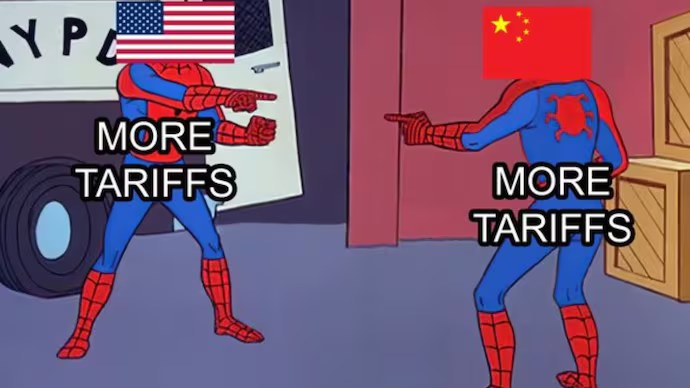
Okay, so the whole thing about Trump’s tariffs blew up. It was everywhere. On the news, on social media, I heard about it left and right and I’m sitting there wondering WTF is a tariff??
Well, I did some research and here’s how Trump’s tariffs are affecting international relations, working class Americans and YOU (if you’re Australian).
So, what is a tariff?
Tariffs are ‘[taxes] imposed on imported goods’. Essentially, goods being sold to the U.S. must pay tax, usually paid by importers when the goods are crossing the border 1.
On April 2nd, Trump announced a new wave of tariffs, starting at 10%, for key imports, basically hoping for the U.S. economy to thrive 2. Australia got lucky and faced the minimum of 10% on most goods 3. China, on the other hand, was not so lucky and got written down on the U.S.’ naughty list, getting hit with 54% tax on goods (not all goods) imported into the U.S. 4.
Sure, Australia avoided the worst, but we aren’t untouched. Because of all the beef between China and the U.S., Australia might feel indirect consequences 5.
So, how is Australia getting impacted?
We got off lightly, but that doesn’t mean we’re in the clear. Because of the tariffs, Australia’s key sectors like the National Farm Federation and our red meat industry may face struggles 6.
Albanese was NOT impressed with Trump’s move, calling them ‘unwarranted’ and having ‘no basis in logic’ 7.
Quickly, Albanese then went onto making a 5-point plan to defend Australia’s national interest, and provided $50 million to the most affected sectors, particularly the red meat industry. Even in the midst of the national election, he is aiming to resolve this issue if the Labour party is successful this year 8, showing the importance of maintaining a strong alliance with the U.S.
Now, let’s talk about why the Trump administration didn’t impose extreme tariffs on Australia.
- As mentioned before, the U.S. and Australia are basically best buds. It’s probably not a good idea for Trump to raise our tariffs if he wants to maintain a strong alliance.
- Australia is also in a trade deficit with the U.S, which means that Australia buys (imports) more goods and services from the U.S. than it sells (exports) to the U.S. In 2023, Australia sold 33.6 billion goods and services to the U.S and imported 65.1 billion 9.
Given this trade imbalance, the U.S. has little reason to raise tariffs on Australia – especially because our trade relationship is much smaller compared to China or South Korea 10.
When China gets taxed, American families pay the price
As you may have heard, China has been wiped out with Trump’s harsh tariffs. It all started in February when the U.S. set a 10% baseline rate for all goods being imported from China 11.
However, the U.S. decided that 10% wasn’t enough and upped it to 125%, with some Chinese products being set at an even higher 145% 12. I mean, come on. 145% is ridiculous.
I understand Trump’s intentions – hoping to boost the U.S. economy – but the consequences are concerning.
China is like the star quarterback in global trade. Disrupting the massive trade relationship between the two countries can seriously hurt the U.S. 13.
Just in 2024 alone, China exported 438.9 billion worth of goods to the U.S, representing 11% of U.S. trade 14. They supply significant amounts of electronics, machinery, furniture to the U.S 15.
So how does this affect Americans?
Trump’s extreme tariffs recently forced China to slow down exporting to the U.S 16. For the U.S., this means less stock on the shelves; Trump admitted this himself, stating that kids “will have 2 toys instead of 30” 17.
As a result, daily essentials like clothing, household products, electronics have become more expensive and harder to access for the average American family 18.
According to Yale Budget Spending, it is projected that Trump’s tariffs will add on an average of $4,900 per American household 19.
These tariffs are hitting working class families the hardest – the very ones struggling to make ends meet. Not to mention, U.S’s GDP has weakened the dollar 20 and may lead to higher unemployment 21.
I thought Trump’s slogan was Make America Great Again?
Trump’s tariffs may have started out with good intentions, but so far, they’ve added pressure onto the global trade 22, the U.S. economy and working-class families. The trade war is far from over, and we’re probably just starting to see the damage.
So… What’s The Bigger Picture?
It’s not the first time a tariff war has happened between the U.S. and China – it’s BEEN happening since 2018 23. Yes, Trump wants to boost the U.S. economy, but he also wants to send a message.
Trump wants China to play fair in the trading game instead of getting “ripped off by China” 24.
The president called China the “king of ripping off the United States” 25 (which I thought was hilarious) and in the past has accused China for supplying cheap steel in international markets 26 and violating their pledged agreement to not commit “cyber-enabled theft of intellectual property” 27.
But instead of negotiating and solving the issue, Trump reignited a whole trade war.
Both nations have been battling it out by increasing their tariff rates and global markets got caught in the middle.
The result so far?
- The global market is struggling: there are shortages and an increase in price worldwide 28.
- Relations between China and the U.S. have gotten worse (I mean, how much worse can it get at this point?), and so have other countries’ relationships with the U.S. 29.
- China is not backing down in this trade war: Chinese businessmen and exporters are selling to South America and the Middle East 30.
If tensions between the U.S. and other nations continue to rise, inflation will continue to increase, making it more difficult for families trying to make ends meet.
There will inevitably be pressure on diplomatic relations and the global trade market to continue exporting and importing at a steady rate.
So what does this mean for the rest of us just trying to fill our fuel tank or buying groceries?
Groceries might cost more, your phone might get pricier, and clothes shopping could hurt your bank account a little more than usual.
References
- 1 Department of Foreign Affairs and Trade. 2025. “Latest on US Tariffs.” Australian Government Department of Foreign Affairs and Trade. 2025. https://www.dfat.gov.au/trade/trade-and-investment/latest-us-tariffs.
- 2 Picchi, Aimee. 2025. “Trump Reveals These 2 New Types of Tariffs on What He Calls ‘Liberation Day,’ April 2.” Cbsnews.com. CBS News. April 2, 2025. https://www.cbsnews.com/news/liberation-day-trump-tariffs-explained/.
- 3 Department of Foreign Affairs and Trade, “Latest on US Tariffs.”
- 4 Dorn, Sara. 2025. “Trump Announces Reciprocal Tariff Rates—54% for China, 20% on EU (Live Updates).” Forbes, April 2, 2025. https://www.forbes.com/sites/saradorn/2025/04/02/trump-announces-reciprocal-tariff-rates-54-for-china-20-on-eu-live-updates/.
- 5 Hameiri, Shahar. 2025. “Trump’s Tariffs Explained.” UQ News. 2025. https://www.uq.edu.au/news/article/2025/04/trumps-tariffs-explained.
- 6 Dick, Samantha. 2025. “Albanese Outlines Five-Point Plan to Respond to Donald Trump’s Tariffs.” Abc.net.au. ABC News. April 3, 2025. https://www.abc.net.au/news/2025-04-03/albanese-outlines-five-point-plan-trump-tariffs-election-2025/105131590.
- 7 Newling, Nick, Olivia Ireland, and Lachlan Abbott. 2025. “As It Happened: ASX Tumbles after Trump Confirms 10 per Cent Tariffs on All Australian Goods; PM Says Decision ‘Unwarranted.’” The Sydney Morning Herald. April 3, 2025. https://www.smh.com.au/politics/federal/federal-election-2025-live-updates-pm-won-t-rule-out-wto-action-if-trump-s-liberation-day-tariffs-hit-australia-abc-funding-to-be-scrutinised-under-dutton-government-20250402-p5lomt.html.
- 8 Dick, Samantha. 2025. “Albanese Outlines Five-Point Plan to Respond to Donald Trump’s Tariffs.” Abc.net.au.
- 9, 10 Hameiri, Shahar. 2025. “Trump’s Tariffs Explained.” UQ News. 2025. https://www.uq.edu.au/news/article/2025/04/trumps-tariffs-explained.
- 11 Zhu, Kayla. 2025. “Visualizing China’s Dependence on U.S. Trade.” Visual Capitalist. February 5, 2025. https://www.visualcapitalist.com/visualizing-chinas-dependence-on-u-s-trade/.
- 12 News, ABC. 2025. “China to Increase Tariffs on US Goods to 125 per Cent, up from 84 per Cent.” Abc.net.au. ABC News. April 11, 2025. https://www.abc.net.au/news/2025-04-11/china-to-increase-us-tariffs-to-125-per-cent/105168174.
- 13 Bureau, US Census. 2024. “International Trade.” http://Www.census.gov. December 2024. https://www.census.gov/foreign-trade/statistics/highlights/topyr.html.
- 14, 15 Lopez, Edwin. 2025. “What Does the US Import from China?” Supply Chain Dive. April 25, 2025. https://www.supplychaindive.com/news/what-does-us-import-from-china/746291/.
- 16 KURTENBACH, ELAINE. 2025. “China’s Export Orders Dip in April as Trump’s Tariffs Begin to Bite.” ABC News. April 30, 2025. https://abcnews.go.com/Business/wireStory/chinas-export-orders-dip-april-trumps-tariffs-begin-121305426.
- 17 LoGiurato, Brett. 2025. “Trump on Tariffs: ‘Maybe the Children Will Have 2 Dolls instead of 30.’” Yahoo Finance. Yahoo Finance. May 1, 2025. https://finance.yahoo.com/news/live/trump-tariffs-live-updates-china-eases-tariffs-on-select-us-goods-as-trump-says-beijing-will-eat-the-costs-191201015.html?guccounter=1&guce_referrer=aHR0cHM6Ly93d3cuZ29vZ2xlLmNvbS8&guce_referrer_sig=AQAAADFHDes7xIrZaUFYe7q4BxOtNQh5AVkGrdgFotvlbMtZ1ofUB_OnlJGPxaYQbSSHuCdKFwLFC1WHKArc0AjJaskWqRXpowZy3T5MRVQNDU3KKc2n2q4pJLoXUROYvVQ4ONqE-rzNWQATZFL2Hd5BCBvChkPjTwf85zu1rHDknUb1.
- 18, 19 Narea, Nicole. 2025. “What Is — and Isn’t — Getting Pricier under Trump’s Tariffs?” Vox. May 2025. https://www.vox.com/politics/411249/trump-tariffs-price-increase-china.
- 20 Aratani, Lauren. 2025. “US Economy Shrinks in First Quarter of Trump 2.0 amid Sweeping Tariffs.” The Guardian. The Guardian. April 30, 2025. https://www.theguardian.com/business/2025/apr/30/economy-gdp-q1-trump-tariffs.
- 21 Reserve Bank of Australia. 2024. “Economic Growth.” Reserve Bank of Australia. Reserve Bank of Australia. 2024. https://www.rba.gov.au/education/resources/explainers/economic-growth.html.
- 22 Wootson Jr., Cleve R, Michael Birnbaum, and Rachel Siegel. 2025. “Trump Ran on Boosting Prosperity. Now, Economic Uncertainty Grows.” The Washington Post. May 2025. https://www.washingtonpost.com/politics/2025/05/01/trump-economy-recession-tariffs/.
- 23 Siripurapu, Anshu, and Noah Berman. 2024. “The Contentious US-China Trade Relationship.” Council on Foreign Relations. May 14, 2024. https://www.cfr.org/backgrounder/contentious-us-china-trade-relationship.
- 24, 25 Ziwen, Zhao. 2025. “South China Morning Post.” South China Morning Post. May 2025. https://www.scmp.com/news/china/diplomacy/article/3308635/trump-believes-good-chance-china-trade-deal-us-envoy-says-no-talks-under-way.
- 26 Trewin, Nikki, Daiki Sato, and Adrian Lu. 2024. “‘It’s You, Not Me’: China’s Subsidies and Global Trade Tensions – Australian Institute of International Affairs.” Australian Institute of International Affairs. October 22, 2024. https://www.internationalaffairs.org.au/australianoutlook/its-you-not-me-chinas-subsidies-and-global-trade-tensions/.
- 27 Yong, Nicholas . 2023. “Industrial Espionage: How China Sneaks out America’s Technology Secrets.” BBC News, January 16, 2023, sec. China. https://www.bbc.com/news/world-asia-china-64206950.
- 28 Partington, Richard. 2025. “Global Markets in Turmoil as Trump Tariffs Wipe $2.5tn off Wall Street.” The Guardian. The Guardian. April 3, 2025. https://www.theguardian.com/business/2025/apr/03/global-markets-turmoil-trump-tariffs-wall-street-downturn.
- 29 Puri, Samir. 2025. “President Trump’s Tariffs Increase Pressure on Allies to Reduce Security Dependence on the US.” Chatham House – International Affairs Think Tank. April 14, 2025. https://www.chathamhouse.org/2025/04/president-trumps-tariffs-increase-pressure-allies-reduce-security-dependence-us.
- 30 Bicker, Laura. 2025. “Trump’s Tariffs: A Defiant China Looks beyond American Buyers.” BBC, April 30, 2025. https://www.bbc.com/news/articles/cwy7jdn09lxo.
 Small World, Big Issues