
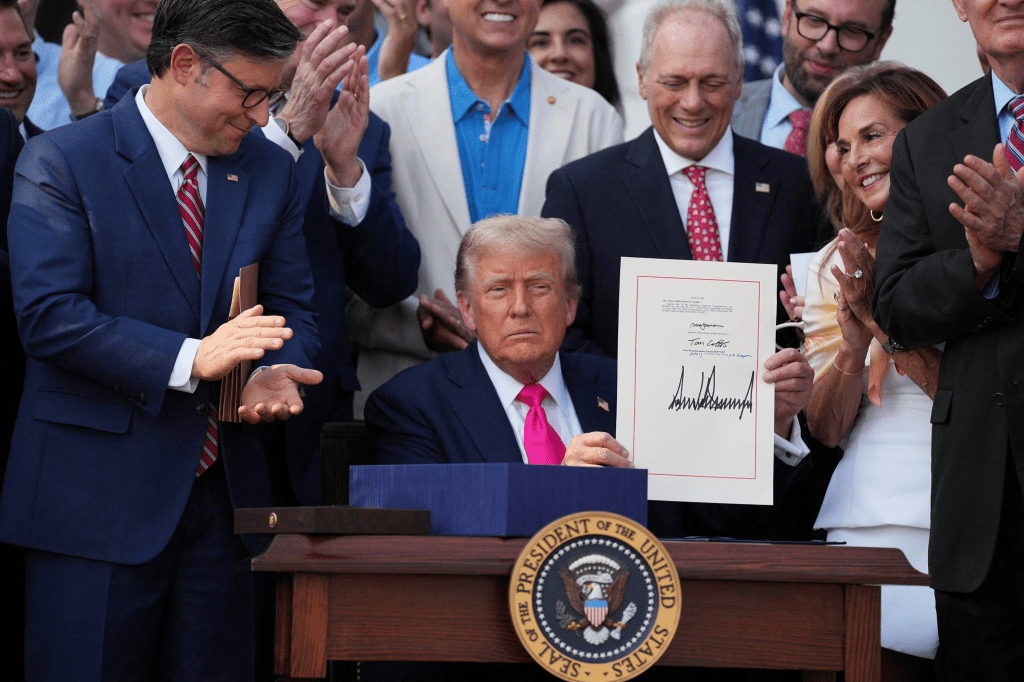
Donald Trump’s newly signed legislation, known as the ‘big beautiful bill’, has sparked controversy. While it promises tax relief for some Americans, it also severely cuts vital support programs such as Medicaid and food stamps. Here’s a brief breakdown on the bill:
Who Supported the Bill?
On July 4, Trump’s ‘big beautiful bill’ was signed into law. This supposed ‘big, beautiful bill’ has drawn criticism, even Republicans in the Senate struggled to decide whether to pass the bill.
Senator JD Vance cast the tie-breaking vote in implementing this law. All Democrats in the chamber voted against Trump’s bill, and three Republican representatives – from Maine, North Carolina and Kentucky – joined the Democrats.
When the bill passed, Senate Republicans acknowledged the decision in applause, contrary to Democrats shaking their heads and sinking into their seats.
Medicaid
Medicaid is a program essential to providing healthcare access to millions who earn low incomes, have disabilities, or limited resources. Thanks to Medicaid, low-income families can receive the treatment and medication that they need.
Without adequate funding towards Medicaid, hospitals and clinics will be forced to close as fewer patients will be insured and able to access healthcare. This will be particularly severe in rural areas with a smaller population and community health centres.
With the current bill, Medicaid federal funding is estimated to be reduced by $1 trillion, according to Congressional Budget Office. Due to the lack of funding, it is estimated that the number of uninsured Americans will increase by 11.8 million by 2034.
Additionally, the bill imposes 80 hour per month work requirements for able-bodied Americans between the ages of 19 to 64.
This has caused some concerns among those reaching retirement age as “after age 50, employment becomes increasingly difficult” due to age discrimination and physical limitations.
Cutting federal funding for health insurance, that over 70 million citizens rely on, is cruel. Everyone should have access to health care, yet it seems like society is moving backwards, placing restrictions on those who need the help most.
Food Stamps
American families relying on food stamps to cover their grocery bill and put food on the table will also be faced with funding cuts.
Although not immediate, 22.3 million families will lose some of their SNAP benefits. SNAP is a program helping low-income older adults and disadvantaged families purchase necessary groceries.
On average, it’s estimated that families will lose $146 in SNAP support, likely leading to challenges in putting food on the table.
Benefits for the Average American Family
Trump’s bill isn’t all bad – but it’s far from amazing.
Middle-class workers will receive tax cuts depending on their income bracket.
The lowest income bracket is set to remain at 10%, but for the second bracket, instead of increasing to 15%, it will remain at 12%. Tax breaks also apply for other income brackets.
There is also a deduction of $750 for individuals, $1,500 for married couples and $1,125 for the head of a household. These deductions will be effective in the 2025 tax year.
While the bill offers some relief to middle-class Americans, high-income Americans are set to gain. The top 20% of earners will have a nearly $13,000 increase in their net income per year, after tax.
For the top 0.1% earners, the income increase is even higher. According to Penn Wharton, the annual income gain is estimated to be more than $290,000.
Once again, it feels as though the system is working in reverse – rewarding those who lack need and punishing the vulnerable.
Yes, middle-class Americans receive some tax benefits. However, the top income earners are reaping most of the reward. Those who struggle financially should be receiving more support from the government, compared to high-income earners.
Conclusion
Trump’s ‘big beautiful bill’ isn’t so beautiful anymore. It slashes funding for Medicaid and food stamps, programs that millions of Americans depend on just to get by.
While middle-class families receive some tax relief, the bill disproportionately benefits high-income earners, despite their lack of need.
In the end, Trump’s bill prioritises wealth over welfare – leaving behind those who need the government’s support the most.
Image:
Millis, Leah. 2025. President Donald Trump Presents a Sweeping Spending and Tax Legislation, Known as the “One Big Beautiful Bill Act,” after H Signed It, at the White House in Washington, D.C., July 4, 2025. ABC News. https://abcnews.go.com/Politics/trump-sign-controversial-spending-bill-white-house-4th/story?id=123482017.
 Small World, Big Issues