
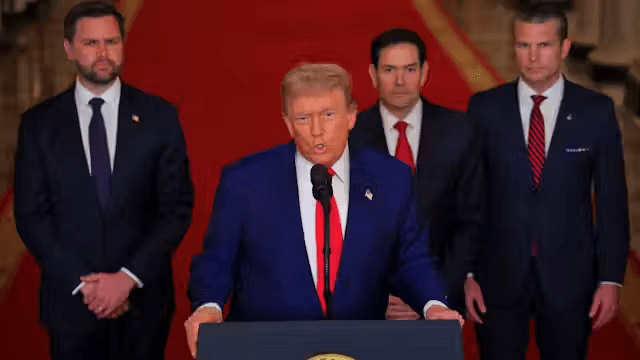
Commencing on June 16, Israel conducted Operation “Mission Lion”, launching coordinated missile strikes targeting Iran’s critical nuclear infrastructure, accusing the country of having dangerous intentions with their nuclear program. Since then, violence has escalated between Iran and Israel, both exchanging airstrikes. Despite the UN urging for diplomacy and “to give peace a chance”, diplomatic efforts have so far failed. Just yesterday, the U.S. joined Israel in bombing Iran’s key nuclear sites, without congressional approval.
Why is Iran’s Nuclear Program Dangerous?
Iran has spent decades building its nuclear program, a significant factor in their sense of national pride . They possess ample amounts of uranium, a key ingredient for both nuclear energy and weapons.
While Iran continues to claim its nuclear program is for “peaceful measures”, the international community, particularly Israel, aren’t convinced.
Enriching uranium to 90% purity is essential to create a nuclear bomb, and in 2023, the IAEA (International Atomic Energy Agency) confirmed that Iran had reached 83.7% purity – alarmingly close.
According to the UN watchdog, there is no other nation that occupies that much uranium without also having a nuclear program.
Today, it only takes one week to produce enough enriched uranium for a bomb, leading other nations to become suspicious of Tehran’s true intentions.
The rapid progress, along with Iran’s strained relations with Israel and Western powers, fuels international anxiety over Iran’s real motivations.
The Past Week (and a bit): Israel Tries to Destroy Iran’s Nuclear Program
Beginning June 16, Israel conducted attacks targeting Iran’s essential nuclear sites. Israel has claimed to have significant damage on Iranian nuclear sites, including Natanz, Isfahan and Fordow, but at what cost?
According to Iran’s health ministry, Israeli strikes have killed over 430 people and injured more than 3,500. Millions of Iranians are being displaced from their homes, evacuating to find shelter and food. Iranians are clinging to the hope of returning to a normal life, concerned about constantly being ‘under threat of military action’.
In the first wave of explosions in Iran, bombs killed the nation’s top military commanders, including the army chief of staff Maj Gen Mohammad Bagheri.
Airstrikes also targeted the homes of Iranian nuclear scientists, killing at least 14, according to Israeli claims.
Iran retaliated with aerial strikes, killing 24 people, according to Israel. They struck dozens of sites, including military centres and air bases.
Despite nations urging for the two countries to restrain and choose peace, Iran declared that they will refuse to negotiate while attacks continue to rain down on their country.
U.S. Becomes the Heart of the Middle East War
Originally, Trump enforced a two-week delay, leaving room for diplomacy between Iran and Israel until he would finalise how to proceed.
However, on June 22, only a few days after his announcement of a two week delay, Trump declared that the U.S. conducted “very successful strikes” on Iran, targeting the three key nuclear sites.
One of the sites America targeted was Fordow, a nuclear site buried under a mountain and Iran’s best-protected nuclear site.
Trump announced that Iran’s nuclear sites were “totally obliterated” and that “Iran must now agree to end this war”.
Despite Trump’s confident speech, Iran nuclear organisation spokesman reported that the Fordow nuclear site experienced limited damage, challenging Trump’s claim of total destruction.
It seems as though Iran isn’t going to surrender: Iran’s television commentator announced that “every American citizen and military personnel… is now a target.
Iran’s Prime Minister also stated that the “Americans must receive a response to their aggression” to the French president.
This was confirmed by Iran’s supreme leader, Ali Khamenei, whose message aired on state television following the strikes: “The Iranian nation is not one to surrender. Americans should know that any military involvement by the US will undoubtedly result in irreparable damage to them.”
Mixed Opinions
America’s attack on Iran has been controversial, some supporting his actions, while others express deep criticism.
Israel’s Prime Minister, Netenyahu, congratulated Trump on his “bold” actions, claiming that they would significantly help the Middle East to a “future of prosperity and peace”.
However, some have expressed strong disapproval, including U.S’ most senior military official, reporting that it is “way too early” to know the amount of damage caused by the U.S.
Many Republicans have been supportive of Trump’s bombing of Iran, however, some are worried about how the U.S. could be stuck in the middle of a lengthy Middle Eastern war.
Moreover, some elected representatives argue Trump should have consulted Congress, as the Constitution required congressional approval before declaring war.
Despite Trump announcing that the Republican party was united during the decision-making process, opposing, vocal Republican representatives such as Kentucky’s Thomas Massie, have expressed deep disapproval of Trump’s actions.
Democratic representatives have expressed extreme disappointment in Trump’s actions.
Hakeem Jeffries, a Democratic leader in the House of Representatives, said Trump has “misled the country about his intentions” referring to Trump’s promise to end wars, but instead involving the U.S. into one.
UN Urges for De-escalation
On June 20, United Nations Secretary-General António Guterres addressed the UN Security Council, in a desperate plea for Israel and Iran to de-escalate the current conflict.
He described the current conflict as a “fire that no one can control” and that the two nations “are racing towards crisis”.
He emphasised the importance of diplomacy, saying that the “only way to bridge the trust gap is through diplomacy, not destruction”.
Despite the UN’s call for peace, Iran’s recent statements suggest diplomacy remains unlikely.
Calls for a peaceful resolution aren’t coming from the UN alone, as several nations have asked Iran and Israel to “return to talks”.
In this situation, I agree that Iran and Israel should solve their issue with diplomacy. The death toll is increasing and millions of Iranian civilians are displaced, hurrying to evacuate and find shelter.
Uncertainty is rising in both nations and “90 million Iranians have been thrown into a state of uncertainty, frustration and anger while trying to maintain hope”.
De-escalation is necessary before it becomes a full-out war.
Without urgent diplomacy, this conflict risks spiralling into a full-scale war with devastating global consequences.
References:
Image: Barria, Carlos . 2025. The US Has Entered the Israel-Iran War. Here Are 3 Scenarios for What Might Happen Next. The Conversation. https://theconversation.com/the-us-has-entered-the-israel-iran-war-here-are-3-scenarios-for-what-might-happen-next-259509.
 Small World, Big Issues