
Why I’m Writing This
Feel free to skip my ramble and jump to the debate section.
I rewrote this piece many times until I was finally satisfied with the outcome, and it was frustrating. It was extremely difficult balancing my ideologies and arguments in an organised and digestible manner, writing in an assertive voice, but not accusatory.
This post is for those curious or critical of Korea’s feminism movement – especially Korean anti-feminist thinkers. This blog post isn’t to attack, but to understand, engage and shift perspectives. I’m a Korean woman, and while I stand by feminism, I’m open to hearing opposing views, as long as we discuss in a respectful manner.
This debate will be focused on the rise of anti-feminism in Korea.
The Argument Against the Gender Equality Ministry
A common argument is that Korea’s Gender Equality Ministry is outdated 1 and that it overemphasises women’s rights in Korea.
For context: the Gender Equality Ministry strives to improve Korean society by promoting gender-equal culture, advancing women’s rights and supporting women return to the work force after career interruptions 2.
Former President Yoon Suk Yeol was motivated to abolish the organisation, accusing the ministry of treating men as “potential sex criminals” 3.
This argument is also supported by Yoon’s claim that the abolishment of the ministry would strengthen the “protection of women, families and the socially weak” 3, by eliminating judgement on sexes, but rather on merit 4.
This argument may stem from the belief that feminism is female supremacy 5, not gender equality, especially with things like women-only spaces and the continuous 4B movement. But is female supremacy truly what feminism stands for?
What the Ministry Actually Does
The ministry isn’t a pedestal for women to outshine men, it’s a support system for women for those facing sexual violence and discrimination 6. It exists because gender-based issues still exist.
The ministry aims to:
- Fight workplace and political discrimination
- Supporting survivors of sexual violence
- Promoting balanced gender representation in government and policy-making roles 7
If the ministry was abolished, what message would that send to other developing nations and to Korean women?
An organisation advocating for women’s rights and providing support for sexual abuse victims 8 isn’t outdated. Abolishing an organisation like this is.
Destroying the ministry won’t eliminate sexism, it will erase necessary protection for Korean women.
Korean women still face safety risks.
In 2022, a 28-year-old woman was fatally stabbed to death at a subway station by her three year stalker, who didn’t have a restraining order despite prior police involvement 9.
The ‘Reverse Discrimination’ Claim
Some men will argue that more women in government sectors or public sectors will mean less opportunities for men. But that fear isn’t supported by data or evidence.
South Korea has one of the highest gender pay gaps – a shocking 31% 10. Korea is far from gender equality in the workplace. Adding more women to public sectors isn’t ‘reverse-discrimination’ 11, it’s just long overdue.
Women in Leadership Improve Performance
Studies have shown that gender diverse teams demonstrate increased performance.
A study published in Human Resource Management showed that higher gender representation in their board of directors and top management teams demonstrated increased innovation and improved firm performance 12.
More women representation in leadership and government roles doesn’t weaken performance or negatively impact results, it increases innovation and contributes an alternative perspective 12.
Why Men Feel Threatened and Why it Matters
Anti-feminists who believe feminists are ‘man-haters’ 13, may be because they feel threatened that traditionally conservative sectors are more inclusive to women who are high-performing 14.
Some anti-feminist attitudes may stem from feelings of threat among men, particularly as traditionally male-dominated sectors can become more inclusive of high-performing women 14.
I’m not just assuming; a study published by Organisational Behavior and Human Decision Processes’ results showed that men who perceive threats to their gender identity, such as reporting to a female supervisor, are more likely to respond with negative workplace behaviours 14.
The Gender Equality Ministry isn’t placing women above men – it’s striving for a decrease in gender inequality. Whether you choose to admit it or not, gender inequality is still prevalent in South Korea, compared to other developed countries.
The Argument Against Feminism
A common argument used by Korean men is that feminism isn’t needed.
Some argue eliminating feminism would create more equality between men and women, claiming feminism promotes ‘female supremacy’ 15. Others believe focusing on women’s rights actually increases gender inequality by neglecting men 16.
Feminism Exists Because Inequality Exists
Feminism wouldn’t have to exist if men and women were truly treated equally and didn’t face gender-based discrimination.
Unfortunately, that is not the reality today.
Advocating for women’s rights and freedom remains essential, especially in Korea, where the inequality gap is substantial.
This is evident in the staggering 31% gender pay gap 17, women experiencing gender-based violence such as stalking 18, molka (몰카) cameras, AI deepfake pornography, gender-based motivated murder, work place sexual harassment, lack of female representation in leadership roles, public sectors and the list goes on.
Advocating for women is necessary because the Korean government has yet to take sufficient action.
The Cost of Inaction
In early 2023, the Gender Equality Ministry proposed a revised version of rape laws in Korea, asking for non-consensual sex to be included under the legal definition of rape.
This updated legal definition would follow UN’s definition 19, however, the Ministry of Justice refused this proposal.
Today, the definition of rape remains as sexual intercourse by means of ‘violence or intimidation’, highlighting the idea that non-consensual intercourse isn’t rape 19.
Change isn’t happening fast enough.
History has shown that murders of Korean women have occurred and don’t plan to stop. In 2016, a woman in her twenties was fatally stabbed in a public restroom by a man who claimed he was seeking revenged against all the women who looked down on him 20.
As mentioned earlier, the tragic case of the fatally stabbed 28-year-old by her stalker the day before his sentencing highlights the urgent need for stronger protections for women 20.
These protections are necessary to address other issues such as molka cameras, small cameras hidden in female restrooms or changing rooms, used to blackmail the victim or share illicit content online.
A notorious example would be the Nth room, a case from 2018 to 2020, that exploited girls and women by trading sexual abuse content in mass, exclusive group chats 21. Over 260,000 people have accessed these chatrooms, gaining access with cryptocurrency or their own sexual abuse videos 22.
Why Feminism Needs to be Pushed Today
Feminism isn’t trying to take away something from men – it’s about giving women what they’ve been denied: safety, representation and respect. If we truly want equality, we need to talk about the challenges.
References
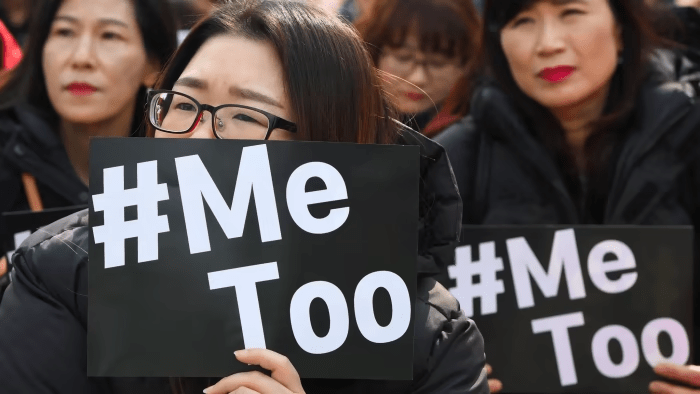
Image: AFP. 2018. Women’s Rights Activists Say Only about 10 per Cent of Sex Crimes Are Reported in South Korea. Financial Times. https://www.ft.com/content/8d305ed2-2381-11e8-ae48-60d3531b7d11.
- Mackenzie, Jean. 2022. “As South Korea Abolishes Its Gender Ministry, Women Fight Back.” BBC News, December 14, 2022, sec. Asia. https://www.bbc.com/news/world-asia-63905490.
- Ministry of Gender Equality and Family. 2024. “Ministry of Gender Equality & Family Republic of Korea.” Www.mogef.go.kr. 2024. https://www.mogef.go.kr/eng/index.do.
- McCurry, Justin. 2022. “Outcry as South Korean President Tries to Scrap Gender Equality Ministry to ‘Protect’ Women.” The Guardian. October 7, 2022. https://www.theguardian.com/world/2022/oct/07/outcry-as-south-korean-president-tries-to-scrap-gender-equality-ministry-to-protect-women.
- Arin, Kim. 2022. “[Exclusive] Abolishing Gender Equality Ministry ‘Premature’ for Korea, Warns OECD Economist – the Korea Herald.” The Korea Herald. March 14, 2022. https://www.koreaherald.com/article/2812749.
- Jung, Han Wool. 2023. “A New Variation of Modern Prejudice: Young Korean Men’s Anti-Feminism and Male-Victim Ideology.” Frontiers in Psychology 14 (14). https://doi.org/10.3389/fpsyg.2023.1230577.
- Mackenzie, Jean. 2022. “As South Korea Abolishes Its Gender Ministry, Women Fight Back.” BBC News, December 14, 2022, sec. Asia. https://www.bbc.com/news/world-asia-63905490.
- Ministry of Gender Equality and Family. 2024. “Ministry of Gender Equality & Family Republic of Korea.” Www.mogef.go.kr. 2024. https://www.mogef.go.kr/eng/index.do.
- Mackenzie, Jean. 2022. “As South Korea Abolishes Its Gender Ministry, Women Fight Back.” BBC News, December 14, 2022, sec. Asia. https://www.bbc.com/news/world-asia-63905490.
- Mackenzie, Jean. 2022a. “Seoul Subway Murder Sparks Fury over South Korea’s Stalking Laws.” BBC News, September 22, 2022, sec. Asia. https://www.bbc.com/news/world-asia-62998084.
- The Straits Times. 2024. “South Korea’s Gender Pay Gap Worst in OECD.” The Straits Times, May 25, 2024. https://www.straitstimes.com/asia/east-asia/south-korea-s-gender-pay-gap-worst-in-oecd.
- Bicker, Laura. 2022. “Why Misogyny Is at the Heart of South Korea’s Presidential Elections.” BBC News, March 8, 2022, sec. Asia. https://www.bbc.com/news/world-asia-60643446.
- Wu, Jie, Orlando C. Richard, María del Carmen Triana, and Xinhe Zhang. 2021. “The Performance Impact of Gender Diversity in the Top Management Team and Board of Directors: A Multiteam Systems Approach.” Human Resource Management 61 (2). https://doi.org/10.1002/hrm.22086.
- Choe, Sang-Hun. 2022. “The New Political Cry in South Korea: ‘out with Man Haters.’” The New York Times, January 1, 2022, sec. World. https://www.nytimes.com/2022/01/01/world/asia/south-korea-men-anti-feminists.html.
- Leavitt, Keith, Luke (Lei) Zhu, Anthony Klotz, and Maryam Kouchaki. 2022. “Fragile or Robust? Differential Effects of Gender Threats in the Workplace among Men and Women.” Organizational Behavior and Human Decision Processes 168 (January): 104112. https://doi.org/10.1016/j.obhdp.2021.104112.
- Jung, Han Wool. 2023. “A New Variation of Modern Prejudice: Young Korean Men’s Anti-Feminism and Male-Victim Ideology.” Frontiers in Psychology 14 (14). https://doi.org/10.3389/fpsyg.2023.1230577.
- Bicker, Laura. 2022. “Why Misogyny Is at the Heart of South Korea’s Presidential Elections.” BBC News, March 8, 2022, sec. Asia. https://www.bbc.com/news/world-asia-60643446.
- The Straits Times. 2024. “South Korea’s Gender Pay Gap Worst in OECD.” The Straits Times, May 25, 2024. https://www.straitstimes.com/asia/east-asia/south-korea-s-gender-pay-gap-worst-in-oecd.
- Mackenzie, Jean, and Frances Mao. 2023. “South Korea Stalker Jailed 40 Years for Killing Woman in Subway.” Www.bbc.com, February 7, 2023. https://www.bbc.com/news/world-asia-64552871.
- Bergsten, Susanné Seong-eun . 2023. “South Korea Cancels Plans to Update Definition of Rape.” Human Rights Watch. February 1, 2023. https://www.hrw.org/news/2023/02/01/south-korea-cancels-plans-update-definition-rape.
- Mackenzie, Jean. 2022a. “Seoul Subway Murder Sparks Fury over South Korea’s Stalking Laws.” BBC News, September 22, 2022, sec. Asia. https://www.bbc.com/news/world-asia-62998084.
- ECPAT International IN Online Exploitation. 2020. “Social Media Messaging Apps Host Underground Child Sexual Abuse Networks.” ECPAT. December 15, 2020. https://ecpat.org/story/social-media-messaging-apps-host-underground-child-sexual-abuse-networks/.
- De Souza, Nicole. 2020. “The Nth Room Case and Modern Slavery in the Digital Space | Lowy Institute.” Www.lowyinstitute.org. April 20, 2020. https://www.lowyinstitute.org/the-interpreter/nth-room-case-modern-slavery-digital-space.
 Small World, Big Issues