
The Root of the Conflict
After Myanmar gained independence from Britain in 1948, Myanmar became a socialist state and fell under military rule from 1962 to 2011 1 . This period brought deep suffering to the Myanmar people, marked by mass killings of civilians, extreme poverty and severe food shortages 2.
The military, Tatmadaw, are extremely inflexible and solely believe that they are the leaders uniting the country. They cling onto their remaining power while committing atrocities, killing civilians, including children and tearing families apart 3.
Burmese civilians and ethnic organisations demonstrated resistance against the military government by mass protests, civilians joining armed civilian groups and ethnic armed organisations (who have been seeking independence for a long period) 4.
There was a period of time when the full military force came to a halt in 2011. Myanmar transitioned to a liberalised nation when a new civilian government was introduced. In 2015’s election, democracy won by a wide margin, led by Aung San Suu Kyi 4.
However, Tatmadaw managed to maintain power in the government and in 2021 performed a coup d’etat, detaining leaders of the democratic party, accusing them of fraud during the 2020 election 4.
Since then, Tatmadaw has held onto their power.
A Nation in Uprising
Now, Tatmadaw has been overwhelmed with the number of groups fighting for liberation. The military government has lost significant patches of territory, dozens of towns, military battalions and even two regional commands (a military organisational unit) 4.
Myanmar’s ongoing war is concerning.
In September 2024, the UN reported 3.3 million displaced civilians (likely underestimated) and over 5,000 deaths 5. Today, the death count increases, as well as the number of families lacking shelter and essential needs 5.
Tatmadaw have been cruel: mass killings, torching villages, stripping human rights and over 4000 airstrikes since February 2021 6. They have displayed fierce brutality, yet civilians persevere to fight for their freedom.
Despite the military junta’s brutality, ethnic organisations and resistance groups have taken over significant chunks of land. According to a 2024 BBC report, 42% of Myanmar is controlled by resistance groups and ethnic armies, compared to the Myanmar Military’s 21% 7.
‘Myanmar’s pro-democracy government, The National Unity Government, is cautiously optimistic’ 8 that the resistance movement will soon overthrow Tatmadaw.
However, this war doesn’t have an easy resolution. Other observing nations aren’t getting involved enough and Tatmadaw and the resistance groups have uncompromising views on how the nation operates. There is a slim possibility of a mutually agreed upon solution.
A Solution
International pressure. Pressure from other nations, particularly states under ASEAN (Association of Southeast Asian Nations).
ASEAN, an international organisation, is motivated to provide stability and peace in Southeast Asian regions 9.
Although ASEAN has aspiring goals made to benefit Southeast Asian nations, there’s been many controversies surrounding ASEAN’s hypocrisy with their principles.
One of ASEAN’s notable policies include a non-interference rule 10.
This rule indicates Southeast Asian countries to detach from each other’s domestic affairs, aiming to promote peace between countries and avoid overstepping boundaries 10.
This prevents countries from getting directly involved in stopping the horrible civil war in Myanmar 10.
If countries are prohibited from involvement in other nation’s domestic issues, how is peace and stability meant to be promoted?
Additionally, countries in ASEAN have differing views on the ongoing war. In 2021, Vietnam and the Philippines have stated that Myanmar’s war is an internal matter, contrary to Indonesia and Malaysia who were concerned over the conflict 10.
Over the years, ASEAN has tried to defuse the war in Myanmar 10.
They proposed a 5-point-plan for Myanmar to relieve the situation but have failed to successfully execute it 10.
ASEAN operates by consensus, which means all states in ASEAN must agree for action to happen. This creates a difficult situation for defusing Myanmar’s war as nations have differing opinions 10.
In 2021, the grouping’s countries worked with the UN to take bold measures against the military rule. However, when states voted on the resolution, Thailand, Laos, Cambodia and Brunei disagreed 10.
Why can’t these nations agree?
Cambodia has rarely voted for democracy in the past 10.
They believe that the pro-democracy government, The NUG, can have enough impact to relieve the war. Cambodia and other ASEAN nations believe the civil war should be ‘Myanmar people-owned and led’ 10.
Also, there are external countries that are supporting the violence in Myanmar.
The largest influence on Myanmar, China, continues to supply and export weapons, armoury and tanks to Myanmar. Because of this, there isn’t a lack of machinery or weaponry for the military rule to stop 10.
However, with time and continued consistent effort, ASEAN can be a catalyst for change. They should:
- Continue to host meetings with involved nations and come to a unanimous agreement. ASEAN needs to encourage their members to be vocally critical of Tatmadaw 10.
- Stop supporting Tatmadaw by exporting weaponry and machinery over to Myanmar 10.
- Rally international pressure. The U.S., China, Russia. Countries that have substantial influence over Myanmar need to step in and place pressure on Tatmadaw to stop committing atrocities and mass killings 10.
In the past couple of weeks, ASEAN has progressed towards substantially positive outcomes.
On May 21, an open letter was sent to Malaysia’s Prime Minister, condemning Malaysia’s leadership regarding ASEAN. Malaysia is leading ASEAN 2025 and ASEAN nations have accused Malaysia for leading with hypocrisy rather than principle 11.
They urged His Excellency to lead ASEAN in 2025 with a stronger stance to positively impact Myanmar’s people 11.
Over 280 organisations supported this open letter, asking His Excellency to cut ties with the military junta and hold positive, progress-filled engagement with the NUG and ethnic resistance organisations in Myanmar 11.
Additionally, they criticised the Prime Minister’s previous and recent meeting with military junta representatives, labelling them as an act of hypocrisy 11.
The letter also urged that the military junta be excluded in all meetings including the upcoming summit in 2025 11.
I wholeheartedly agree with this open letter.
The open letter held His Excellency accountable, yet it was solution-focused and encouraged Malaysia to take the first step in creating change that would help stop the civil war.
This letter pressed Malaysia’s Prime Minister for responsible and urgent action, especially due to several earthquakes that occurred earlier this year and the military junta’s actions following.
The two 7.4 magnitude earthquakes in central Myanmar have killed more than 3,700 civilians and thousands of people are displaced 12.
The letter accuses ASEAN’s sector for providing humanitarian aid for failing to deliver meaningful and effective aid, allowing Tatmadaw to weaponise humanitarian support for their advantage 13.
Concurring with the open letter, I agree that this year’s summit and Malaysia’s leadership could be a monumental shift to end Myanmar’s civil war.
With unified international pressure and clear, decisive action, ASEAN – lead by Malaysia – can help promote democracy and ensure a brighter future for the people of Myanmar.
References:
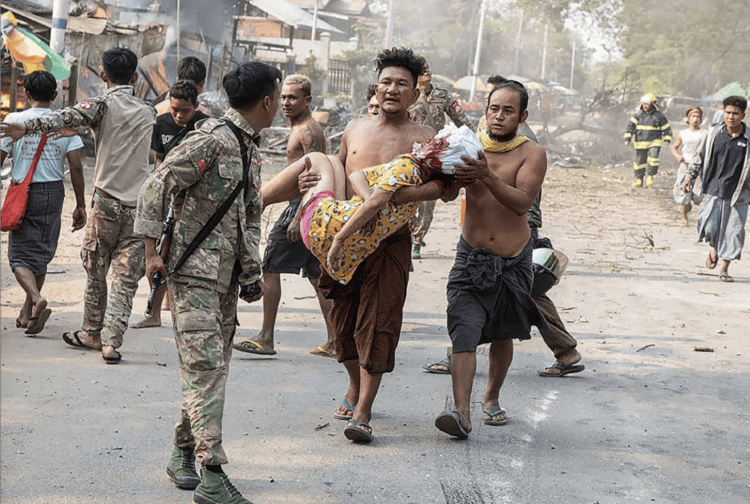
Image: Getty Images. 2025. Injured Civilian Being Carried Following Aerial Bombardments by Myanmar’s Military in Singu Township in Central Mandalay Region on 14 March 2025. Geographical Magazine. https://geographical.co.uk/news/myanmar-a-country-at-war-with-itself.
- Ratcliffe, Rebecca. 2025. “Why Is Myanmar Embroiled in Conflict?” The Guardian. January 31, 2025. https://www.theguardian.com/global-development/2025/jan/31/why-is-myanmar-embroiled-in-conflict.
- Maizland, Lindsay. 2022. “Myanmar’s Troubled History: Coups, Military Rule, and Ethnic Conflict.” Council on Foreign Relations. January 31, 2022. https://www.cfr.org/backgrounder/myanmar-history-coup-military-rule-ethnic-conflict-rohingya#chapter-title-0-3.
- Ngeth, Sovena. 2021. “Myanmar Military Coup: Explained | IYOPS.” IYOPS. February 22, 2021. https://www.iyops.org/post/myanmar-military-coup-explained.
- Ratcliffe, Rebecca. 2025. “Why Is Myanmar Embroiled in Conflict?” The Guardian. January 31, 2025. https://www.theguardian.com/global-development/2025/jan/31/why-is-myanmar-embroiled-in-conflict.
- UN News. 2024. “Myanmar: Intensified Conflict Leaves 3.3 Million Displaced.” UN News. September 17, 2024. https://news.un.org/en/audio/2024/09/1154446.
- Nyan Lynn Thit Analytica. 2025. “Aerial Attacks Carried out by the Military Council ,” February. https://nyanlynnthit-my.sharepoint.com/personal/eit_nyanlynnthit_org/_layouts/15/onedrive.aspx?id=%2Fpersonal%2Feit%5Fnyanlynnthit%5Forg%2FDocuments%2FReport%2DPaper%5FNLTA%2FFinal%20Report%20Folder%2FALL%20Research%20Papers%2FPapers%20%26%20Special%20Reports%2FSpecial%20Reports%2FSpecial%20Report%20%28Air%20Strike%29%2FAerial%20Attacks%20conducted%20by%20the%20military%20council%5FSeptember%5FDecember2024%5FEng%2Epdf&parent=%2Fpersonal%2Feit%5Fnyanlynnthit%5Forg%2FDocuments%2FReport%2DPaper%5FNLTA%2FFinal%20Report%20Folder%2FALL%20Research%20Papers%2FPapers%20%26%20Special%20Reports%2FSpecial%20Reports%2FSpecial%20Report%20%28Air%20Strike%29&ga=1.
- Henschke, Rebecca. 2024. “Soldier-Spies in Myanmar Help Pro-Democracy Rebels Make Gains.” BBC, December 20, 2024. https://www.bbc.com/news/articles/c390ndrny17o.
- Day, Lauren. 2024. “How the Most Fractured Nation on Earth Is Coming Together to Overthrow a Goliath.” Abc.net.au. ABC News. November 9, 2024. https://www.abc.net.au/news/2024-11-10/inside-myanmar-civil-war/104525864.
- Maizland, Lindsay, Eleanor Albert, Lynn Hong, and Carlos Galina. 2023. “What Is ASEAN?” Council on Foreign Relations. September 18, 2023. https://www.cfr.org/backgrounder/what-asean.
- Saha, Premesha. 2024. “Finding an End to the Myanmar Crisis: ASEAN’s Massive Task.” Orfonline.org. OBSERVER RESEARCH FOUNDATION ( ORF ). November 13, 2024. https://www.orfonline.org/research/finding-an-end-to-the-myanmar-crisis-asean-s-massive-task.
- Burmese Rohingya Organisation UK (BROUK). 2025. “Open Letter: Malaysia Must Lead ASEAN with Principle, Not Hypocrisy, to Address the Myanmar Crisis – Burmese Rohingya Organisation UK (BROUK).” Burmese Rohingya Organisation UK (BROUK). May 22, 2025. https://brouk.org.uk/open-letter-malaysia-must-lead-asean-with-principle-not-hypocrisy-to-address-the-myanmar-crisis/.
- Seng, Chit. 2025. “ASEAN Chair Should Lead Efforts to Hold the Myanmar Junta Accountable.” Thediplomat.com. The Diplomat. May 26, 2025. https://thediplomat.com/2025/05/asean-chair-should-lead-efforts-to-hold-the-myanmar-junta-accountable/.
 Small World, Big Issues