
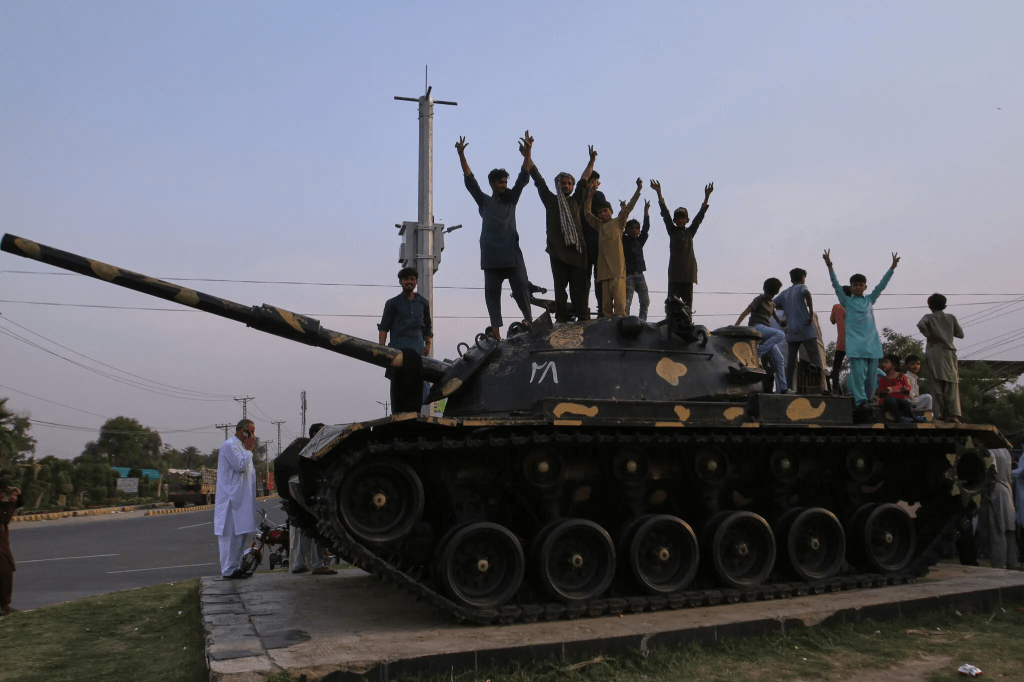
India and Pakistan have settled for a ceasefire – but what led up to this moment and what comes next?
In this post, I’ll break down the U.S.’s role in the ceasefire, the aftermath of the agreement and how Pakistan is dealing with the broken Indus Water Treaty.
To recap, over the past 5 days, violence escalated, with civilian deaths caused by the back-and-forth drone strikes and airstrikes between India and Pakistan 1.
What began as a minor conflict turned into something serious, raising international concerns over the possibility of a nuclear war 1.
On Saturday morning, Seth Krummrich, a former United States colonel described the conflict as one of the “most violent and concerning escalation” he’s witnessed in years 1.
The U.S. Steps In
By Saturday evening, Trump posted on social media that both countries have agreed to a “full and immediate” ceasefire 2. This relieved both the Pakistani and Indian community, preventing what could have been a major war 3.
This came days after the U.S. commented that the war was “none of our business”, highlighting a sudden shift in their approach 4.
While Pakistan had launched 300-400 drones to India, the key trigger for U.S’s involvement was when India struck Rawalpindi’s Nur Khan Air Base in Pakistan 4.
Yet, just earlier last week, the United States reported that the war has “nothing to do with America’s ability to control it” 5. This raises the question: could there have been other motives to the United States’ engagement?
The United States’ behaviour doesn’t align – but countries and families are relieved that the violence has come to an end for now 6.
This base is crucial – it’s the strategic coordination hub, housing aircraft and serving as the Air Mobility Command’s control site 7.
More importantly, the Nur Khan Air Base is close to a site where Pakistan stores approximately 170 warheads and oversees its nuclear arsenal 8.
Pakistan’s deepest fear is losing control of their nuclear sites, according to an American former official familiar with Pakistan’s nuclear program 8. India’s blatant attack on Pakistan’s cherished air bases was seen as a warning to Pakistan of the power imbalance between the two countries.
Having witnessed the severity in violence and concluding that involvement of nuclear weapons could be a real possibility, JD Vance, the United States Vice President, engaged with Indian and Pakistan officials, including their prime ministers 8.
Following the United States involvement, the two countries had agreed to discuss a ‘broad set of issues at a neutral site’ (though these issues aren’t specified) and settled for an immediate ceasefire 9.
Pakistan expressed their appreciation for the U.S’s engagement for de-escalating tensions. On the contrary, India announced that the agreement was discussed directly with Pakistan, without mention of the U.S 9.
Violation of the Ceasefire Agreement
Only a few hours after India and Pakistan settled for peace, India accused Pakistan for violating their ceasefire agreement. They held Pakistan accountable, asking them to “address violations … with seriousness and responsibility” 10.
Pakistan countered India’s accusations, claiming that India initiated the breaching of the ceasefire regulations. They also commented that they are “committed” to obeying the regulations of the agreement, despite India’s violations 10.
The night the ceasefire was agreed upon, loud blasts and missiles were reported in India-administered Kashmir 11.
India’s Lieutenant General Rajiv Ghai commented that India has hit nine armed group training camps in Pakistan, killing 100 people. None of these claims could be verified by a third party 12, which raises doubts about their accuracy.
The ceasefire is managing to hold down the fort, de-escalating a violent conflict of what could have been the beginning of a nuclear war.
What’s Happening Between India and Pakistan Now?
It seems India and Pakistan have no motivation in mending their relationship yet.
Visa restrictions for either country aren’t easing up. In late April, both Pakistan and India revoked visas for their neighbour country, forcing those affected to flee 13.
Additionally, India is no longer providing support for the Indus Water Treaty 13. The Indus Water Treaty, signed in September 1960, required India to supply water from the Indus River System, in exchange for annual sums 14.
This water treaty provided immense support, relieving pressure for Pakistan’s water crisis. In 2019, 95.8% of Pakistan’s total renewable water resources are from the Indus River System 15.
Even now, Pakistan heavily relies on water coming in from Indus River System. Without India’s support, Pakistan’s water supply will suffer.
Due to rapid population growth and climate change, Pakistan’s groundwater is contaminated with oil and gasoline, which means their groundwater is unsafe to drink 16.
The Pakistani Prime Minister is aware of the dire need of support, asking the international community to actively contribute in regards to the Indus Water Treaty 17, highlighting how severe their water crisis will become without India’s aid.
Taking into consideration the lengthy, complicated relationship between the two countries, I still believe suffocating Pakistan’s insufficient water supply will have devastating effects on families and children.
The Pakistani Prime Minister reported that the changes in the flow of water would be an ‘act of war’ 18.
India remains determined to have “no drop of water of the Indus River’s water [reach] Pakistan” 19.
Already, many Pakistanis have been struggling to source clean and reliable water sources. Following the devastating floods in 2022, over 1,700 citizens lost their lives and 10 million lost access to safe water sources 20.
Moreover, the reduced flow of water doesn’t just affect Pakistani civilians’ access to drinking water, it also affects agriculture.
Without water to grow crops, Pakistani people will “die of hunger” says Thakhur, a Pakistani farmer 21.
The tension between the two countries will only intensify the water crisis.
While India can’t stop the water flow completely without new infrastructure, it can disrupt the timing of water release – pausing the flow unpredictably. Without consistent water flow and uncertainty, Pakistan’s agriculture sector and families face a serious challenge 22.
I’m hopeful that the tension will gradually ease, and the Indus Water Treaty will be reinstated to provide protection and some stability for vulnerable communities in Pakistan.
References
Image: Tanveer, Asim. 2025. Celebrations after the Announcement of a Cease-Fire between Pakistan and India on Saturday in Multan, Pakistan. The New York Times. https://www.nytimes.com/2025/05/10/world/asia/india-pakistan-conflict.html?searchResultPosition=1.
- Das, Anupreeta, Mujib Mashal, and Salman Masood. 2025. “India and Pakistan Announce Cease-Fire but Clashes Persist.” The New York Times, May 10, 2025. https://www.nytimes.com/2025/05/10/world/asia/india-pakistan-conflict.html?searchResultPosition=1.
- Cleary, Olivia-Anne. 2025. “India and Pakistan Agree to a ‘Full and Immediate’ Cease-Fire after U.S.-Led Talks.” TIME. Time. May 10, 2025. https://time.com/7284654/india-pakistan-ceasefire-trump-us-mediation-kashmir-conflict-strikes/.
- Ellis-Petersen, Hannah, Shah Meer Baloch, and Aakash Hassan. 2025. “India and Pakistan Both Claim Victory after Ceasefire Declared.” The Guardian. The Guardian. May 11, 2025. https://www.theguardian.com/world/2025/may/11/india-and-pakistan-both-claim-victory-after-ceasefire-declared.
- Sanger, David E, Julian E Barnes, and Maggie Haberman. 2025. “Reluctant at First, Trump Officials Intervened in South Asia as Nuclear Fears Grew.” The New York Times, May 10, 2025. https://www.nytimes.com/2025/05/10/us/politics/trump-india-pakistan-nuclear.html?searchResultPosition=1.
- Das, Anupreeta, Mujib Mashal, and Salman Masood. 2025. “India and Pakistan Announce Cease-Fire but Clashes Persist.” The New York Times, May 10, 2025. https://www.nytimes.com/2025/05/10/world/asia/india-pakistan-conflict.html?searchResultPosition=1.
- Ellis-Petersen, Hannah, Shah Meer Baloch, and Aakash Hassan. 2025. “India and Pakistan Both Claim Victory after Ceasefire Declared.” The Guardian. The Guardian. May 11, 2025. https://www.theguardian.com/world/2025/may/11/india-and-pakistan-both-claim-victory-after-ceasefire-declared.
- ET Online. 2025. “IAF Strikes 11 Pakistani Airbases, Inflicts Severe Damage; Targets Include Nur Khan, Sargodha, and Skardu.” The Economic Times. Economic Times. May 10, 2025. https://economictimes.indiatimes.com/news/defence/india-pakistan-ceasefire-iaf-strikes-11-pakistani-airbases-inflicts-severe-damage-targets-include-nur-khan-sargodha-and-skardu/articleshow/121060642.cms?from=mdr.
- Sanger, David E, Julian E Barnes, and Maggie Haberman. 2025. “Reluctant at First, Trump Officials Intervened in South Asia as Nuclear Fears Grew.” The New York Times, May 10, 2025. https://www.nytimes.com/2025/05/10/us/politics/trump-india-pakistan-nuclear.html?searchResultPosition=1.
- Das, Anupreeta, Mujib Mashal, and Salman Masood. 2025. “India and Pakistan Announce Cease-Fire but Clashes Persist.” The New York Times, May 10, 2025. https://www.nytimes.com/2025/05/10/world/asia/india-pakistan-conflict.html?searchResultPosition=1.
- News, ABC. 2025. “India-Pakistan Ceasefire Breaks down Just Hours after Truce Was Announced.” Abc.net.au. ABC News. May 10, 2025. https://www.abc.net.au/news/2025-05-10/india-accuses-pakistan-of-ceasefire-violations/105278284.
- Dover, Sam. 2025. “Explosions in Kashmir after India-Pakistan Ceasefire Deal Announced.” SBS News. 2025. https://www.sbs.com.au/news/podcast-episode/explosions-in-kashmir-after-india-pakistan-ceasefire-deal-announced/wm0h8l90m.
- Siddiqui, Usaid, and Urooba Jamal. 2025. “India-Pakistan Live: Uneasy Calm after Ceasefire Gets off to Shaky Start.” Al Jazeera. May 11, 2025. https://www.aljazeera.com/news/liveblog/2025/5/11/india-pakistan-live-pakistan-committed-to-truce-india-claims-breaches.
- Mashal, Mujib. 2025. “The Danger for India and Pakistan Has Not Gone Away.” The New York Times, May 11, 2025. https://www.nytimes.com/2025/05/11/world/asia/india-pakistan-war-analysis.html?smid=nytcore-ios-share&referringSource=articleShare&sgrp=c&pvid=01E6AA50-B085-419B-BD94-9BAD2E9C318D.
- Bauer, Patricia. 2019. “Indus Waters Treaty | History, Provisions, & Facts.” In Encyclopædia Britannica. https://www.britannica.com/event/Indus-Waters-Treaty.
- Maqbool, Nazam. 2022. “Water Crisis in Pakistan: Manifestation, Causes and the Way Forward.” PIDE. 2022. https://pide.org.pk/research/water-crisis-in-pakistan-manifestation-causes-and-the-way-forward/.
- Azizullah, Azizullah, Muhammad Nasir Khan Khattak, Peter Richter, and Donat-Peter Häder. 2011. “Water Pollution in Pakistan and Its Impact on Public Health — a Review.” Environment International 37 (2): 479–97. https://doi.org/10.1016/j.envint.2010.10.007.
- Today, India. 2025. “Pakistan Ceasefire Violation Highlights: After India’s Action, Pak PM Says Committed to Faithful Ceasefire.” India Today. May 9, 2025. https://www.indiatoday.in/india/story/india-pakistan-tensions-live-update-operation-sindoor-blackout-india-pak-war-missile-drone-attack-pahalgam-terror-attack-air-strike-2721927-2025-05-09.
- Martin, Patrick. 2025. “Pakistan Warns India That Changes to Indus Waters Treaty an ‘Act of War.’” Abc.net.au. ABC News. April 24, 2025. https://www.abc.net.au/news/2025-04-25/pakistan-warns-india-indus-water-treaty-changes-act-of-war/105214372.
- Shahid, Ariba, and Krishna N Das. 2025. “Panic in Pakistan as India Vows to Cut off Water Supply over Kashmir.” Reuters, April 27, 2025. https://www.reuters.com/world/asia-pacific/panic-pakistan-india-vows-cut-off-water-supply-over-kashmir-2025-04-27/.
- Shah, Simmone. 2025. “Climate Change Is Straining Pakistan’s Water. Tensions with India Could Make It Worse.” TIME. Time. May 9, 2025. https://time.com/7284470/india-pakistan-water-supply-climate-change/.
- Shahid, Ariba, and Krishna N Das. 2025. “Panic in Pakistan as India Vows to Cut off Water Supply over Kashmir.” Reuters, April 27, 2025. https://www.reuters.com/world/asia-pacific/panic-pakistan-india-vows-cut-off-water-supply-over-kashmir-2025-04-27/.
- Shah, Simmone. 2025. “Climate Change Is Straining Pakistan’s Water. Tensions with India Could Make It Worse.” TIME. Time. May 9, 2025. https://time.com/7284470/india-pakistan-water-supply-climate-change/.
 Small World, Big Issues